Fifth Bolivian Congress of Constitutional Law (Sucre)
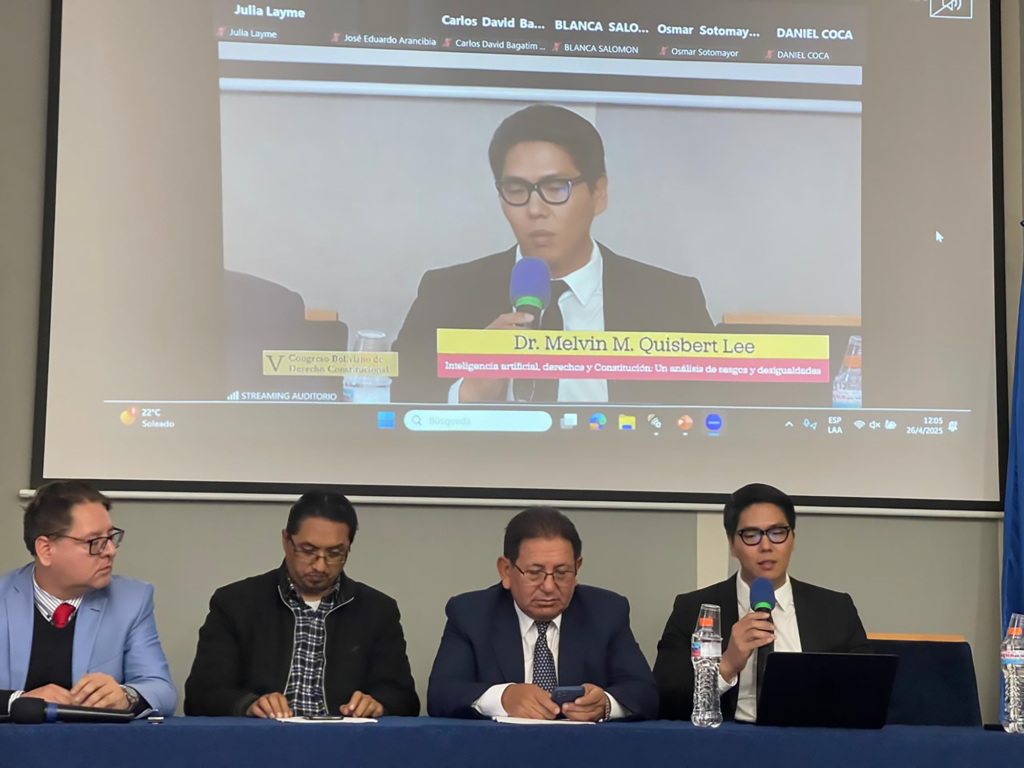
Sucre has a particular quality when it fills with lawyers. In late April 2025 the constitutional capital hosted the V Congreso Boliviano de Derecho Constitucional [Fifth Bolivian Congress of Constitutional Law], a gathering that carried a special symbolic weight: it marked two hundred years of our independence under the theme “200 years of constitutionalism: new challenges for the twenty-first century”. Three days of papers, debates and corridor conversations among more than two hundred and forty academics, practitioners and students who share the same preoccupation: understanding what it means to have a Constitution today.
Within that programme, I took part in the Artificial Intelligence panel with a paper I have been developing for some time: “Inteligencia artificial, derechos y Constitución: un análisis de sesgos y desigualdades” [Artificial intelligence, rights and the Constitution: An analysis of bias and inequality]. Its central concern is one that genuinely troubles me — algorithmic systems are not neutral, and that has consequences for the rights to equality and non-discrimination.
Within the time the organisers allowed, my paper opened with a brief introduction to the notion of the “algorithmic society” (Micklitz et al., 2022),1 which marks a break with the classical model of constitutionalism and its exclusive focus on public power. Put differently: companies, platforms and other bodies that are not necessarily public may today be engaged in activities that bear directly on fundamental rights.
Artificial intelligence, moreover, does not produce “neutral” outcomes. It has the capacity to reproduce prejudice and stereotype and, in many cases, to amplify the biases already present in the datasets on which it draws. Those biases take various forms — racism, sexism, ageism and ableism — and their effects reach beyond equality in the abstract to tangible matters: employment, health, finance, education and access to justice.
Bolivia’s Constitution recognises the right to equality and prohibits discrimination (Article 14(II)), yet a gap persists between what the text provides and what happens in practice. The indicators place Bolivia in a troubling position on equal treatment and discrimination. It is telling that, as of 2022, only three discrimination cases had reached judgment. Against that background one question becomes unavoidable: is it, in fact, worth addressing the protection of equality and non-discrimination in artificial intelligence? That question, among others, is what my paper set out to answer.
My thanks to Universidad Católica Boliviana, Sede La Plata, for providing so rewarding a space for the exchange of ideas with the academic community, and to the Academia Boliviana de Estudios Constitucionales, which organised and ran the event and which consistently promotes academic debate on contemporary questions such as the intersection of technology and law.
- Micklitz, H.-W., Pollicino, O., Reichman, A., Simoncini, A., Sartor, G., & Gregorio, G. D. (2022). Constitutional Challenges in the Algorithmic Society. Cambridge University Press. ↩︎